
Contents
Overview
The story of Persinette emerged from the fertile literary landscape of 17th-century France, a period known for its sophisticated fairy tale tradition, often referred to as 'contes de fées.' While the tale shares thematic elements with older folklore, La Force's version is distinctly a literary creation, characterized by its refined prose and psychological depth, hallmarks of the salon culture that patronized such works. Its narrative structure, featuring a young woman confined to a tower and rescued by a prince who climbs her hair, predates the more widely known 'Rapunzel' by over a century, establishing it as a significant precursor. The tale's roots can be traced to the broader motif of the maiden in the tower, a trope found in various mythologies and folk traditions, but La Force's specific articulation cemented its place in literary history.
⚙️ How It Works
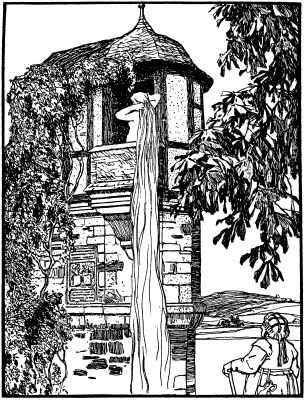
The narrative of Persinette unfolds with a mother's extreme jealousy leading her to abandon her daughter, Persinette, to a sorceress. This sorceress imprisons Persinette in a high tower with no doors. The sorceress climbs Persinette's extraordinarily long hair, which she calls 'gold.' A prince, captivated by Persinette's singing, discovers her predicament and learns the sorceress's method of ascent. He begins visiting Persinette, and they fall in love, eventually devising a plan to escape. Their escape involves weaving a ladder from silk provided by the prince, a stark contrast to the organic hair-climbing method. The story culminates in their successful flight and marriage, while the sorceress, upon discovering their deception, banishes Persinette, leading to a period of hardship before their eventual reunion. The mechanics of the tale hinge on the symbolic use of hair as both a means of confinement and liberation, and the contrast between the sorceress's control and the prince's collaborative escape plan.
📊 Key Facts & Numbers
Persinette, as a literary work, stands as a foundational text within the 'Maiden in the Tower' archetype, Aarne–Thompson type 310. La Force's tale likely influenced numerous other stories within this tradition, though direct attribution can be challenging due to the oral nature of folklore. The narrative's core elements—a tower, long hair as a means of access, and a prince rescuer—are present in Persinette and later versions. The conceptual impact of La Force's tale is undeniable, shaping a narrative trope that has been retold countless times across different media.
👥 Key People & Organizations
The central figure in this tale is, of course, Persinette herself, the young woman whose extraordinary hair becomes both her prison and her eventual means of escape. Charlotte-Rose de Caumont de La Force was a prominent figure in French literary circles during the late 17th and early 18th centuries, known for her prolific output of fairy tales and romances. While the Brothers Grimm, Jacob and Wilhelm Grimm, are not direct creators of 'Persinette,' their collection and adaptation of folk tales, including 'Rapunzel,' are inextricably linked to its legacy, having popularized the motif globally. The sorceress, an unnamed antagonist in La Force's tale, serves as the primary agent of Persinette's confinement, embodying the archetype of the wicked guardian or jealous elder figure common in fairy tales. The prince, a more generic heroic figure, represents the force of romantic love and liberation.
🌍 Cultural Impact & Influence
The motif of the tower and the hair-climbing rescue has been reinterpreted in countless adaptations, from animated films like Disney's 'Tangled' (which draws heavily on the Rapunzel archetype) to theatrical productions and literary retellings. The tale's exploration of themes like isolation, the yearning for freedom, and the power of a unique physical attribute (long hair) has made it a touchstone for discussions on female agency and confinement in storytelling. Its influence extends beyond direct adaptations, permeating the collective imagination as a recognizable fairy tale structure.
⚡ Current State & Latest Developments
As a literary fairy tale from the late 17th century, 'Persinette' is not subject to the same rapid developments as contemporary technologies or media platforms. Its 'current state' is primarily one of academic interest and its continued presence within the broader discourse of fairy tale studies and literary history. While no new 'developments' in the narrative itself are occurring, scholars continue to analyze La Force's work in comparison to oral traditions and later adaptations. The enduring popularity of 'Rapunzel' ensures that the conceptual space occupied by 'Persinette' remains relevant, often discussed in relation to its more famous descendant. The tale's continued inclusion in collections of classic fairy tales signifies its persistent, albeit often uncredited, presence in popular culture.
🤔 Controversies & Debates
Critics and scholars debate the extent to which La Force's literary creation should be credited for the widespread success of the tower-and-hair motif. Some also point to the potentially problematic elements of the narrative, such as the mother's extreme cruelty and the prince's initial deception, which are common in fairy tales but can be subject to modern critical re-evaluation regarding themes of consent and parental responsibility. The debate often centers on the distinction between oral folklore and literary adaptation, and how credit is assigned when a story is retold and transformed across generations and cultures.
🔮 Future Outlook & Predictions
The future outlook for 'Persinette' is intrinsically tied to the continued fascination with the 'Rapunzel' narrative and the broader study of fairy tales. As scholars delve deeper into the origins and evolution of classic stories, 'Persinette' is likely to receive more focused attention, potentially leading to new academic analyses and critical editions. Its thematic resonance—isolation, longing for freedom, and the transformative power of connection—ensures its continued relevance in a world grappling with similar issues. Future adaptations might seek to explicitly acknowledge La Force's original tale, moving beyond the sole focus on the Grimm brothers' version. The potential for 'Persinette' to inspire new creative works that directly engage with its specific narrative nuances, rather than just the broader 'Rapunzel' archetype, remains a promising avenue.
💡 Practical Applications
While 'Persinette' itself is a narrative rather than a technology or product, its structure and themes have found practical application in various creative fields. Its most significant application is as a direct source of inspiration for other creative works, particularly 'Rapunzel' and its myriad adaptations in literature, film, and theater. The tale's narrative arc—confinement, discovery, escape, and eventual triumph—serves as a blueprint for stories exploring similar themes. For writers and storytellers, 'Persinette' offers a foundational example of how to construct a compelling fairy tale, demonstrating the effective use of symbolic elements like the tower and the hair. It also provides a case study for understanding the evolution of folklore into literary forms and the impact of cultural transmission on narrative development.
Key Facts
- Category
- culture
- Type
- topic