
Contents
Overview
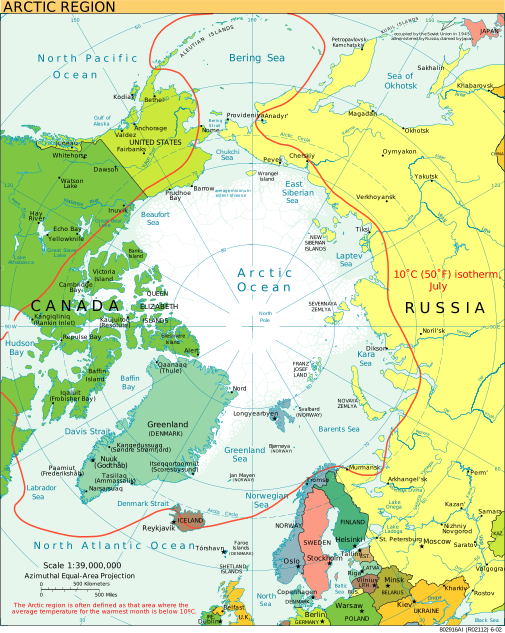
Arctic exploration encompasses the historical and ongoing human endeavor to investigate the Earth's northernmost polar region, an area defined by its extreme climate and unique geography. Over centuries, expeditions, driven by a mix of scientific curiosity, resource discovery, and geopolitical ambition, pushed the boundaries of the known world. The Arctic's formidable challenges—perilous ice, unpredictable weather, and vast distances—have consistently tested the limits of human endurance and technological innovation. Today, Arctic exploration is increasingly focused on scientific research, particularly concerning climate change, while also navigating complex geopolitical and environmental considerations.
🎵 Origins & History
The saga of Arctic exploration begins not with grand expeditions, but with the practical needs of ancient peoples and early mariners. Norse settlers in Greenland ventured into Arctic waters, driven by trade and sustenance. Expeditions in the late 16th and early 17th centuries, though failing to find the passages, mapped significant portions of the Arctic coastline and encountered Indigenous peoples, laying the groundwork for future exploration.
⚙️ How It Works
Arctic exploration is fundamentally an exercise in overcoming extreme environmental conditions through specialized technology and meticulous planning. Early expeditions relied on sturdy wooden ships, often reinforced with iron, capable of withstanding ice pressure, alongside essential survival gear like furs, sleds, and specialized navigational tools such as sextants and chronometers. The advent of steam power in the 19th century, followed by diesel engines and icebreakers in the 20th, dramatically improved transit capabilities. Modern exploration leverages advanced technologies including satellite imagery for ice monitoring, GPS for precise navigation, specialized ice-resistant vessels, helicopters, and remotely operated vehicles (ROVs) for underwater research. Scientific research stations, both permanent and temporary, are crucial for long-term data collection on climate, geology, and biology, often requiring robust infrastructure capable of withstanding Arctic conditions.
📊 Key Facts & Numbers
The sheer scale of the Arctic presents staggering figures for exploration. The Arctic region covers approximately 14 million square kilometers (5.4 million square miles), with the Arctic Ocean alone spanning 12 million square kilometers. Over 1,000 expeditions have been documented since the 16th century, with hundreds of thousands of individuals participating. The search for the Northwest Passage alone spanned over 350 years, involving more than 100 voyages and costing countless lives. In the 20th century alone, over 500,000 square kilometers of Arctic territory were mapped by Soviet and Russian expeditions. The cost of major Arctic expeditions can run into tens of millions of dollars, with scientific research vessels like the Oseberg costing upwards of $50 million to build and operate annually. The potential resource wealth, including an estimated 90 billion barrels of oil and 1,670 trillion cubic feet of natural gas, underscores the economic stakes, estimated at trillions of dollars.
👥 Key People & Organizations
Numerous individuals and organizations have shaped the narrative of Arctic exploration. Early pioneers like Roald Amundsen, the first to navigate the Northwest Passage (1903-1906), and Robert Peary, who claimed to reach the North Pole in 1909, are iconic figures. Scientists like Vladimir Vernadsky laid foundations for understanding Arctic geology and biogeochemistry. Organizations such as the Royal Dutch Geographical Society and the National Geographic Society have funded and promoted numerous expeditions. In the modern era, institutions like the Scott Polar Research Institute at the University of Cambridge and the National Snow and Ice Data Center (NSIDC) are at the forefront of Arctic research. The Arctic Council serves as a crucial intergovernmental forum for cooperation on Arctic issues, including scientific research and environmental protection.
🌍 Cultural Impact & Influence
Arctic exploration has profoundly influenced global culture, inspiring literature, art, and a persistent fascination with the unknown. Tales of harrowing journeys, survival against impossible odds, and encounters with unique wildlife have fueled countless books, films, and documentaries, from Edgar Allan Poe's 'The Narrative of Arthur Gordon Pym of Nantucket' to modern documentaries on climate change. The perceived 'otherness' of the Arctic has also shaped geopolitical narratives, influencing territorial claims and international relations, particularly during the Cold War. Furthermore, the exploration and subsequent scientific study of the Arctic have been instrumental in advancing our understanding of global climate systems, oceanography, and glaciology, providing critical data for environmental science and policy. The resilience and ingenuity of Arctic Indigenous peoples, whose knowledge has been vital to explorers, have also gained wider recognition.
⚡ Current State & Latest Developments
The current era of Arctic exploration is dominated by scientific inquiry, driven by the region's rapid transformation due to climate change. Expeditions are increasingly focused on monitoring sea ice melt, permafrost thaw, and changes in biodiversity. Vessels like the German research icebreaker Polarstern have undertaken ambitious year-long expeditions, such as the MOSAiC expedition (2019-2020), to study the Arctic climate system in unprecedented detail. Geopolitical interest is also resurging as receding ice opens new shipping routes and access to potential resources, leading to increased naval presence and resource exploration activities by Arctic nations. International collaboration remains vital, with initiatives like the International Arctic Science Committee (IASC) coordinating research efforts across borders. The focus is shifting from 'conquest' to 'understanding' and 'stewardship' in a rapidly changing environment.
🤔 Controversies & Debates
Arctic exploration is not without its controversies and debates. The historical narrative often overlooks or marginalizes the contributions and presence of Indigenous peoples, whose lands and cultures were impacted by external expeditions. The pursuit of resources, particularly oil and gas, in the fragile Arctic environment is a major point of contention, with environmental groups like Greenpeace actively campaigning against drilling operations. Debates also surround the geopolitical implications of increased accessibility, with concerns about militarization and potential conflicts over territorial claims and shipping lanes. Furthermore, the very act of scientific exploration can have an environmental footprint, leading to discussions about sustainable research practices and the ethical considerations of studying vulnerable ecosystems. The 'discovery' of the North Pole itself remains a subject of historical debate, with questions about the accuracy of Robert Peary's claims.
🔮 Future Outlook & Predictions
The future of Arctic exploration will be inextricably linked to the trajectory of global climate change and evolving geopolitical dynamics. We can anticipate continued growth in scientific research focused on understanding and predicting the impacts of a warming Arctic, with a greater emphasis on long-term monitoring and integrated ecosystem studies. The opening of new shipping routes like the Northern Sea Route and the Northwest Passage will likely spur increased commercial activity, necessitating further navigational and environmental research. Geopolitically, the Arctic is poised to become an even more significant arena for international cooperation and potential competition, requiring robust diplomatic frameworks. Technological advancements will continue to enable exploration in increasingly remote and challenging areas, potentially leading to new discoveries in geology, biology, and oceanography, but also raising new ethical and environmental questions.
💡 Practical Applications
Arctic exploration yields practical applications across several domains. Scientific data gathered from expeditions is crucial for climate modeling, informing global policies on emissions reduction and adaptation strategies. Understanding permafrost thaw, for instance, has direct implications for infrastructure development in northern regions and for predic
Key Facts
- Category
- history
- Type
- topic