
Contents
Overview
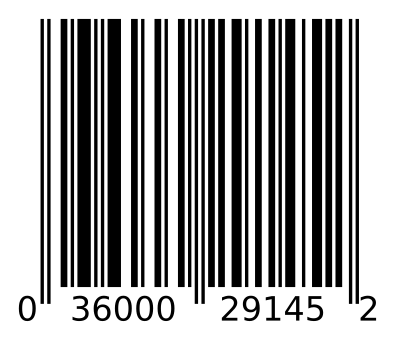
A barcode is a machine-readable optical labeling system that encodes data in a visual format. Initially conceived as parallel lines of varying widths and spaces (1D barcodes), the technology has evolved to include complex two-dimensional (2D) patterns like QR codes and Data Matrix codes. These systems are fundamental to modern logistics, retail, and information management, enabling rapid scanning and data retrieval. The global barcode market is valued in the billions, with billions of items scanned daily across supply chains, inventory management, and consumer interactions. While linear barcodes primarily store alphanumeric data, 2D codes can hold significantly more information, including URLs, contact details, and even encrypted data, revolutionizing how we interact with physical objects and digital information.
🎵 Origins & History
The genesis of the barcode can be traced back to the late 1940s. The technology for widespread implementation, particularly the laser scanning required, wasn't mature. It wasn't until the early 1970s that the concept truly took flight. The first UPC barcode was scanned commercially on a pack of Wrigley's Juicy Fruit gum at a Marsh Supermarket in Troy, Ohio, marking a pivotal moment in retail history. This breakthrough paved the way for the widespread adoption of automated checkout systems, fundamentally altering the retail landscape.
⚙️ How It Works
Barcodes function by encoding data into a series of parallel lines or geometric patterns that can be optically scanned. Linear (1D) barcodes, like the UPC or Code 128, represent data through variations in the width and spacing of black bars and white spaces. A barcode scanner, typically a laser or LED-based device, emits light that reflects off the barcode. The scanner measures the intensity of the reflected light, distinguishing between the dark bars and light spaces, and translates these patterns into binary data. Two-dimensional (2D) barcodes, such as QR Codes and Data Matrix codes, use a grid of squares, dots, or other shapes to store information both horizontally and vertically, allowing for much higher data density. These 2D codes are often read by image sensors or digital cameras, which analyze the pattern to decode the stored information, enabling them to hold URLs, text, and even small images.
📊 Key Facts & Numbers
The global barcode scanner market is projected to grow to over $7 billion by 2030, demonstrating its continued economic significance. The QR code alone sees an estimated 1 billion scans per month globally, highlighting the rapid adoption of 2D symbologies. In inventory management, barcodes can reduce data entry errors by up to 3,000%, saving businesses millions in potential losses. The ISBN system, which uses barcodes for book identification, has cataloged over 40 million unique titles since its inception.
👥 Key People & Organizations
Key figures in barcode development include Norman Joseph Woodland and Bernard Silver, who patented the initial concept. George Lauer is often credited with developing the UPC symbology that became the industry standard. The GS1 organization, formerly the Uniform Code Council, plays a critical role in managing and standardizing barcode systems globally, ensuring interoperability across different industries and regions. Companies like Zebra Technologies and Honeywell are major players in the manufacturing of barcode scanners and printers, driving innovation in scanning technology and data capture solutions. The ISO also sets standards for barcode symbologies, ensuring their reliability and widespread use.
🌍 Cultural Impact & Influence
Barcodes have profoundly reshaped global commerce and information management, moving us from manual data entry to near-instantaneous digital capture. They are the silent backbone of supply chains, enabling efficient tracking of goods from manufacturing to the consumer's hands, a process that underpins the operations of giants like Amazon and Walmart. Beyond retail, barcodes have permeated countless aspects of life: they identify patients in hospitals, track assets in large corporations, and even serve as digital tickets for events. The advent of QR codes has further amplified their cultural impact, transforming static print media into interactive gateways to online content, bridging the physical and digital worlds in unprecedented ways. This ubiquitous presence has fostered a global reliance on these simple visual cues for everything from verifying product authenticity to accessing public transport.
⚡ Current State & Latest Developments
The current landscape of barcode technology is characterized by the increasing sophistication and adoption of 2D codes, particularly QR codes, which have seen a resurgence driven by mobile payments and contactless interactions, especially following the COVID-19 pandemic. Innovations are focused on enhanced data security within barcodes, faster scanning speeds, and integration with IoT devices for real-time tracking and analytics. Companies are exploring 'smart' barcodes that can change their displayed information or integrate with RFID technology for more robust inventory solutions. The development of blockchain-based verification systems is also beginning to leverage barcodes for enhanced product traceability and anti-counterfeiting measures, adding a layer of trust to the data captured.
🤔 Controversies & Debates
A significant debate surrounds the security and privacy implications of 2D barcodes, especially QR codes, which can easily link to malicious websites or facilitate phishing attacks if not generated and scanned responsibly. The potential for data breaches through compromised scanning devices or insecurely stored barcode data remains a concern. Furthermore, the dominance of certain symbologies, like UPC, has led to discussions about vendor lock-in and the need for more open, adaptable standards. There's also an ongoing discussion about the environmental impact of printing billions of labels annually, prompting research into more sustainable materials and digital alternatives. The reliance on these visual codes also raises accessibility questions for individuals with visual impairments, spurring development in alternative identification methods.
🔮 Future Outlook & Predictions
The future of barcodes points towards deeper integration with advanced technologies. We can anticipate barcodes becoming more dynamic, potentially changing content based on time, location, or user interaction, moving beyond static data storage. The convergence with AI and machine learning will enable more sophisticated analytics based on barcode scan data, optimizing supply chains and consumer behavior predictions. The development of 'invisible' or embedded barcodes, integrated directly into product materials, could further streamline tracking without altering aesthetics. Expect to see barcodes evolve into more robust authentication tools, potentially incorporating cryptographic elements to combat counterfeiting and ensure data integrity, especially in high-value industries like pharmaceuticals and luxury goods. The ongoing push for sustainability may also lead to biodegradable or reusable barcode solutions.
💡 Practical Applications
Barcodes are indispensable tools across a vast array of practical applications. In retail, they are the cornerstone of point-of-sale systems, inventory management, and supply chain logistics, enabling efficient stock control and automated checkout. In healthcare, barcodes on patient wristbands and medication ensure accurate patient identification and drug administration, drastically reducing medical errors. Manufacturing utilizes barcodes for tracking components, managing work-in-progress, and ensuring quality control. Logistics and shipping companies, such as FedEx and UPS, rely heavily on barcodes to track packages and manage complex delivery networks. Furthermore, barcodes are used for ticketing at events, managing library books via library systems, and even in scientific research for sample identification and data logging in fields like genomics and DNA barcoding.
Key Facts
- Category
- technology
- Type
- topic