
Contents
Overview
The concept of a cellular boundary predates modern biology. The understanding of the cell's inner, dynamic membrane truly began to crystallize in the late 19th and early 20th centuries. Pioneering work by Ernst Overton in the 1890s suggested that lipid-soluble substances crossed cell surfaces more readily, hinting at a lipidic nature. Later, Irving Langmuir's studies on lipid monolayers in 1917 provided a physical model for how lipids might arrange themselves. The breakthrough came with the proposal of the Davson-Danielli model in 1935, which posited a lipid bilayer sandwiched between two protein layers. This model dominated thinking for decades until experimental evidence, particularly from freeze-fracture electron microscopy and studies on membrane protein mobility, led to its revision.
⚙️ How It Works
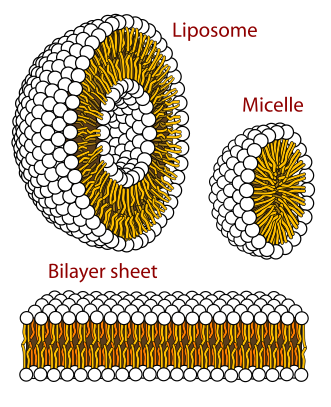
Biological membranes are primarily constructed from a phospholipid bilayer, where hydrophilic phosphate heads face outward towards aqueous environments, and hydrophobic fatty acid tails point inward, creating a barrier to water-soluble molecules. Embedded within or associated with this bilayer are proteins that perform a vast array of functions: transmembrane proteins act as channels and transporters for ions and molecules, receptor proteins bind signaling molecules, and enzymes catalyze reactions. The fluidity of the membrane, described by the fluid mosaic model, allows these proteins to move laterally, facilitating dynamic interactions and cellular processes. This dynamic assembly also includes cholesterol in animal cells, which modulates fluidity, and glycolipids and glycoproteins on the outer surface, involved in cell recognition and adhesion.
📊 Key Facts & Numbers
A typical human cell membrane is only about 7-10 nanometers thick, yet it contains an astonishing diversity of molecules. Phospholipids constitute roughly 50% of the membrane's mass, but there are often more protein molecules by number. In the brain, myelin sheaths, which insulate nerve axons, are composed of up to 76% lipid, making them among the most lipid-rich biological structures. The surface area of the plasma membrane in a typical mammalian cell can be expanded by up to 200-fold by internal folds called microvilli, increasing absorption efficiency.
👥 Key People & Organizations
Key figures in understanding biological membranes include Ernst Overton, whose early work in the 1890s linked lipid solubility to membrane permeability. Irving Langmuir, a Nobel laureate, developed models of lipid monolayers crucial for understanding bilayer formation. Hugh Davson and James F. Danielli proposed the influential, though later revised, sandwich model in 1935. The modern paradigm owes much to S. J. Singer and G. L. Nicolson, who introduced the fluid mosaic model in 1972, revolutionizing our view of membrane dynamics. Organizations like the American Society for Cell Biology and the Biophysical Society foster research and disseminate findings in this field.
🌍 Cultural Impact & Influence
Biological membranes are not just scientific curiosities; they are the very fabric of life that has captured the imagination. The concept of a cell as a distinct, self-contained unit, protected by its outer membrane, is a foundational idea in biology, influencing everything from medicine to our understanding of evolution. The discovery of liposomes—artificial membrane vesicles—has led to their use in drug delivery, a testament to the practical translation of membrane science. The intricate dance of proteins within the membrane has inspired analogies in fields as diverse as computer science (e.g., network protocols) and social dynamics, highlighting the universality of boundary and interaction principles.
⚡ Current State & Latest Developments
Current research on biological membranes is intensely focused on understanding their role in disease and developing novel therapeutic strategies. For instance, the precise mechanisms by which membrane proteins misfold or aggregate in neurodegenerative diseases like Alzheimer's disease and Parkinson's disease are under intense investigation. Advances in cryo-electron microscopy have allowed scientists to visualize membrane protein structures at unprecedented resolution, revealing details crucial for drug design. Furthermore, the development of artificial membrane systems, such as supported lipid bilayers and organelle-on-a-chip technologies, is pushing the boundaries of biomimicry and disease modeling.
🤔 Controversies & Debates
A long-standing debate centers on the precise degree of protein mobility within the lipid bilayer. While the fluid mosaic model posits significant lateral diffusion, evidence suggests that some membrane proteins are anchored or restricted in their movement by interactions with the cytoskeleton or extracellular matrix. Lipid rafts—small, dynamic domains enriched in cholesterol and specific lipids—in organizing membrane proteins and signaling pathways also remain a subject of active research and debate, with some arguing their importance is overstated. Another area of contention involves the exact mechanisms of membrane fusion, critical for processes like exocytosis and viral entry.
🔮 Future Outlook & Predictions
The future of biological membrane research is poised for significant breakthroughs, particularly in the realm of synthetic biology and personalized medicine. Scientists are working towards creating artificial cells with precisely engineered membrane properties for applications in bioremediation and bio-manufacturing. The development of 'smart' drug delivery systems that can target specific cellular membranes or respond to internal cellular cues is a major frontier. Furthermore, understanding how membrane dynamics change with age and disease could unlock new diagnostic tools and regenerative therapies, potentially leading to interventions that restore cellular membrane integrity and function.
💡 Practical Applications
Biological membranes are central to numerous practical applications. Drug delivery systems, particularly liposomes and nanoparticles, leverage membrane principles to encapsulate and transport therapeutic agents, improving efficacy and reducing side effects. In the food industry, emulsifiers mimic membrane behavior to stabilize mixtures like mayonnaise and salad dressings. The biotechnology sector utilizes membrane filtration for purification of pharmaceuticals and water treatment. Biosensors often incorporate membrane proteins or artificial membranes to detect specific analytes, crucial for medical diagnostics and environmental monitoring.
Key Facts
- Category
- science
- Type
- concept