
Contents
Overview
The formal discipline of industry analysis gained significant traction with the publication of Michael Porter's article, 'How Competitive Forces Shape Strategy,' in the Harvard Business Review in 1979. Porter, a professor at Harvard Business School, introduced his Five Forces Framework, which quickly became the cornerstone of strategic management education and practice. Prior to Porter, economic analysis often focused on macro-level factors or individual firm performance, lacking a structured approach to understanding the competitive environment between these two extremes. His work built upon earlier concepts from industrial organization economics, synthesizing them into a practical model for business leaders. This framework provided a common language for executives and consultants to dissect market structures, moving beyond anecdotal observation to a more rigorous, analytical approach to strategy formulation.
⚙️ How It Works
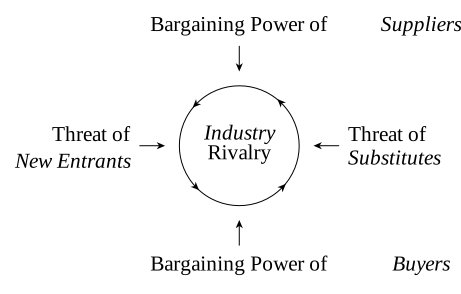
Industry analysis typically involves examining several key dimensions to construct a comprehensive picture. At its core, it assesses the market structure, including the number and size of competitors, barriers to entry, and product differentiation. The most widely adopted model, Porter's Five Forces, evaluates the bargaining power of buyers, the bargaining power of suppliers, the threat of new entrants, the threat of substitute products or services, and the intensity of rivalry among existing competitors. Beyond Porter, analysts also consider PESTEL factors (Political, Economic, Sociocultural, Technological, Environmental, Legal) to understand the broader macro-environmental influences. This systematic approach helps identify an industry's attractiveness, its profit potential, and the strategic levers available to firms within it, often involving extensive data collection and quantitative analysis of market trends and financial performance.
📊 Key Facts & Numbers
The global market for business intelligence and analytics, a direct beneficiary of industry analysis, was valued at approximately $30.3 billion in 2023 and is projected to reach $61.8 billion by 2028, growing at a CAGR of 15.3%. Studies by McKinsey & Company frequently highlight that companies leveraging advanced analytics for strategic decision-making outperform peers by 10-15% in profitability. For instance, the semiconductor industry, a highly concentrated sector, saw its global revenue exceed $527 billion in 2023, with the top 10 firms capturing over 60% of the market share, demonstrating intense rivalry and high barriers to entry. Conversely, the fragmented restaurant industry in the US, with over 1 million establishments, experiences an average profit margin of just 3-5%, underscoring the impact of competitive forces on profitability. These numbers illustrate the tangible outcomes predicted by thorough industry analysis.
👥 Key People & Organizations
The foundational figure in modern industry analysis is undoubtedly Michael Porter, whose work at Harvard Business School revolutionized strategic thinking. His Five Forces Framework and concepts like competitive advantage and value chain analysis are taught in business schools worldwide. Beyond academia, leading consulting firms like McKinsey & Company, Boston Consulting Group, and Bain & Company are major practitioners, employing thousands of analysts to conduct in-depth industry studies for their corporate clients. Organizations such as Gartner and Forrester Research specialize in technology industry analysis, providing critical insights to tech companies and investors. These entities collectively shape how industries are understood and how strategic decisions are made globally.
🌍 Cultural Impact & Influence
Industry analysis has profoundly influenced how businesses perceive their competitive environment and formulate strategy, moving from an internal, resource-centric view to an external, market-centric one. Its concepts are deeply embedded in business education, with Porter's Five Forces being a staple of virtually every MBA program globally. This framework has permeated popular business literature, influencing countless articles in publications like the Wall Street Journal and The Economist, and shaping the discourse around mergers and acquisitions and private equity investments. It has also provided a common analytical language for investors, enabling them to assess the long-term viability and attractiveness of different sectors, from SaaS to renewable energy, thereby guiding capital allocation decisions across the global financial markets.
⚡ Current State & Latest Developments
In 2024, industry analysis is increasingly complex, driven by rapid technological innovation, globalization, and heightened ESG concerns. The rise of Artificial Intelligence and Machine Learning is transforming how data is collected and analyzed, enabling more predictive and granular insights into market dynamics. For instance, the semiconductor industry is currently grappling with geopolitical tensions and supply chain disruptions, forcing analysts to incorporate political risk into their models more rigorously. The electric vehicle market is experiencing intense competition, with new entrants challenging established automotive giants, necessitating continuous re-evaluation of competitive forces. Furthermore, the push for sustainability is reshaping industries from fashion to agriculture, adding new layers of analysis related to regulatory pressures and consumer preferences.
🤔 Controversies & Debates
Despite its widespread adoption, industry analysis, particularly Porter's Five Forces, faces several criticisms. Skeptics argue that the framework can be too static, struggling to account for rapidly evolving industries characterized by disruptive innovation and network effects, common in the tech industry. Critics like Henry Mintzberg contend that strategy is often emergent rather than purely deliberate, making a rigid, analytical framework less applicable in dynamic environments. Another point of contention is its focus on industry structure over firm-specific resources and capabilities, which some argue are more critical for competitive advantage. The debate often centers on whether the framework oversimplifies complex market realities or remains a robust starting point for strategic thinking, even in the age of digital transformation.
🔮 Future Outlook & Predictions
The future of industry analysis will likely be characterized by an even greater reliance on big data and predictive analytics, moving beyond descriptive and diagnostic insights to prescriptive recommendations. The integration of AI tools will automate much of the data gathering and initial analysis, allowing human analysts to focus on higher-level interpretation and strategic implications. We can expect more dynamic models that account for ecosystem competition rather than just direct industry rivalry, as boundaries between sectors blur due to digital convergence. The increasing importance of intangible assets like data, intellectual property, and brand reputation will also necessitate new metrics and frameworks for evaluation. By 2030, industry analysis will be less about static snapshots and more about continuous, real-t
Key Facts
- Category
- technology
- Type
- topic