
Contents
Overview
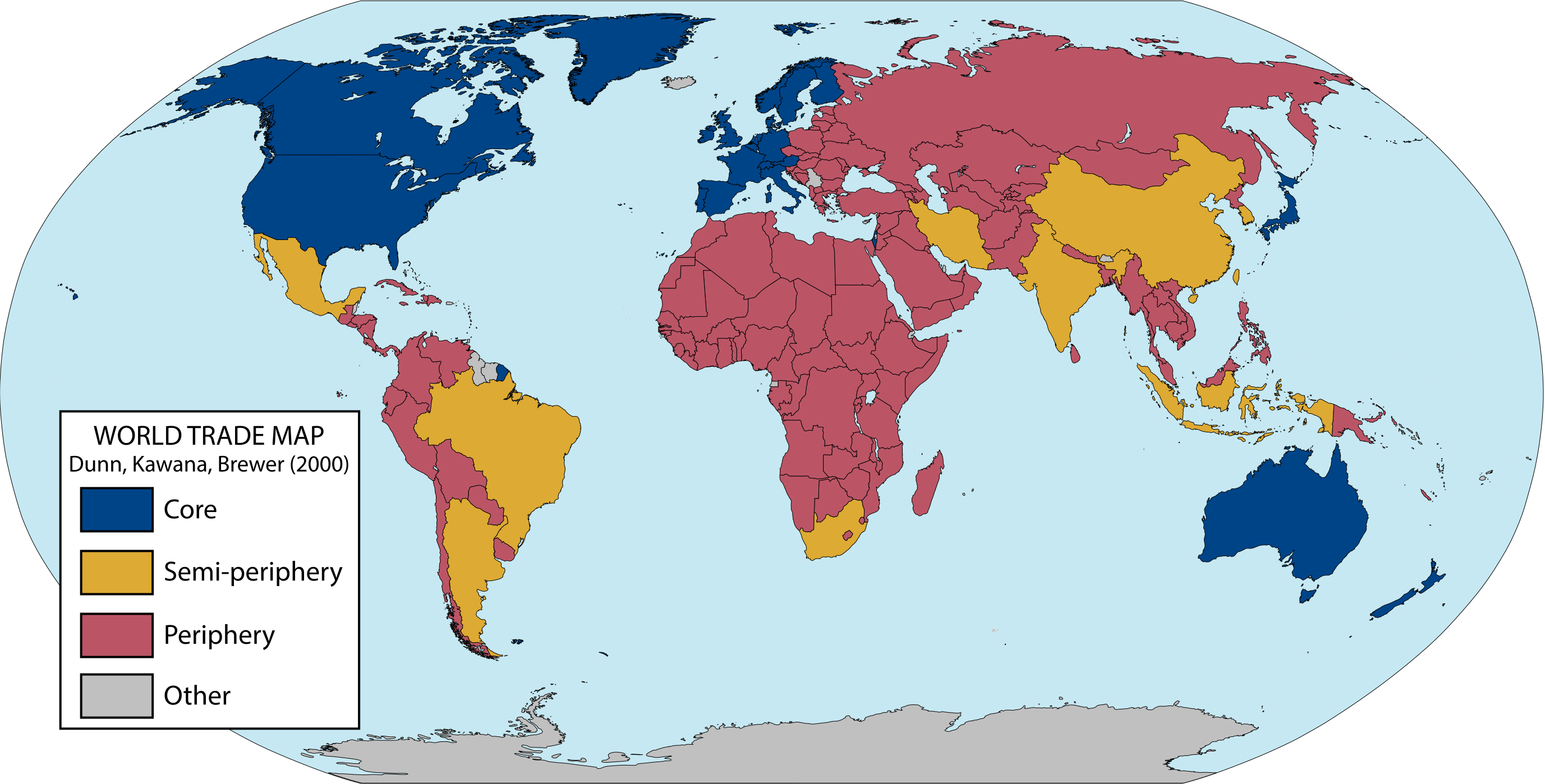
The sociology of globalization is a vibrant, often contentious, field that examines the complex processes by which economies, cultures, and societies become increasingly intertwined across national borders. It moves beyond simple notions of 'globalization' to dissect the power dynamics, social transformations, and emergent inequalities that arise from this interconnectedness. Key theoretical frameworks, such as world-systems theory, dependency theory, and network theory, attempt to map the flows of capital, labor, and information, distinguishing between dominant 'core' regions and exploited 'periphery' regions. This field grapples with phenomena ranging from the spread of global consumer culture and the rise of transnational corporations like Nestlé and Amazon, to the challenges of global governance and the impact of digital technologies like the internet on social structures. It asks critical questions about who benefits and who loses in a globalized world, and how local identities are reshaped by global forces.
🎵 Origins & History
The academic study of globalization, particularly through a sociological lens, gained significant traction in the latter half of the 20th century, though its roots can be traced to earlier analyses of imperialism and international trade. Early precursors include the work of Immanuel Wallerstein and his development of world-systems theory in the 1970s, which posited a global capitalist system divided into core, semi-periphery, and periphery nations. This framework, building on dependency theory articulated by scholars like Andre Gunder Frank, challenged the modernization theories prevalent in the post-WWII era. The acceleration of global trade, facilitated by institutions like the World Trade Organization (WTO) and technological advancements like the internet, further spurred sociological inquiry into the multifaceted nature of global interconnectedness, leading to the emergence of distinct subfields focusing on economic, cultural, and political globalization.
⚙️ How It Works
The sociology of globalization operates by analyzing the flows and structures that transcend national boundaries. This involves examining how capital moves through global financial markets, often driven by entities like BlackRock and Goldman Sachs. It scrutinizes the migration of labor, from skilled professionals moving to Silicon Valley to undocumented workers contributing to economies in places like Qatar. Furthermore, it investigates the dissemination of ideas, cultural products, and norms, whether through global media conglomerates like Disney or through the viral spread of memes on platforms like TikTok. Sociologists employ social network analysis to map these connections, understanding how global institutions, non-governmental organizations (NGOs) like Amnesty International, and even individual actions contribute to and are shaped by global processes.
📊 Key Facts & Numbers
The scale of globalization is staggering. In 2023, global trade in goods and services reached an estimated $35 trillion, a figure that has grown exponentially since the 1980s. Foreign direct investment (FDI) flows amounted to over $1.3 trillion in 2023, with multinational corporations (MNCs) like Samsung operating in over 70 countries. The digital realm amplifies this reach; in 2024, over 5.3 billion people, approximately 66% of the global population, are internet users, with social media platforms like Facebook connecting billions daily. Remittances, money sent home by migrants, represent a significant economic force, totaling over $800 billion in 2023, particularly vital for economies in countries like the Philippines. The global tourism industry, prior to the pandemic, saw over 1.4 billion international tourist arrivals annually, showcasing the movement of people as well as goods.
👥 Key People & Organizations
Key figures in the sociology of globalization include Immanuel Wallerstein, whose world-systems theory remains foundational. Manuel Castells provided critical insights into the 'network society' and the role of information technology. Ulrich Beck introduced the concept of the 'risk society' in a globalized context, highlighting new forms of transnational threats. Saskia Sassen has extensively analyzed the role of global cities and the formation of transnational communities. Organizations like the International Monetary Fund (IMF) and the United Nations (UN) are crucial actors shaping and responding to global processes, while influential think tanks like the Brookings Institution publish extensive research on global trends.
🌍 Cultural Impact & Influence
The cultural impact of globalization is profound and often debated. It has led to the widespread dissemination of Western consumer culture, evident in the global ubiquity of brands like McDonald's and Coca-Cola. This phenomenon, sometimes termed 'cultural homogenization' or 'McDonaldization' by critics like George Ritzer, raises concerns about the erosion of local traditions. Conversely, globalization also facilitates the spread of non-Western cultural forms, such as K-Pop music and Bollywood cinema, demonstrating a more complex interplay of global and local forces, often referred to as 'glocalization'. The rise of global media platforms like Netflix and Spotify has further reshaped how cultural content is produced, consumed, and shared worldwide.
⚡ Current State & Latest Developments
In 2024, the sociology of globalization is grappling with several key developments. The ongoing geopolitical shifts, including the rise of China as a global economic power and increased tensions between major powers, are reshaping global trade and investment patterns. The COVID-19 pandemic (2020-2022) exposed the vulnerabilities of hyper-globalized supply chains, prompting discussions about 'reshoring' and 'friend-shoring' of production, impacting companies like Apple. The rapid advancement of artificial intelligence (AI) and automation presents new questions about the future of labor and the potential for widening global inequalities. Furthermore, the growing urgency of climate change necessitates unprecedented global cooperation, yet often clashes with national interests and existing global economic structures.
🤔 Controversies & Debates
The sociology of globalization is rife with controversy. A central debate revolves around whether globalization primarily benefits a global elite, exacerbating income inequality between and within nations, or if it offers opportunities for development and poverty reduction, as argued by proponents of free trade. Critics, drawing on world-systems theory, point to the persistent exploitation of peripheral nations for raw materials and cheap labor by core nations, citing examples like the extraction of minerals in the Democratic Republic of Congo to fuel industries in South Korea. Others debate the extent of cultural homogenization versus the resilience and adaptation of local cultures, questioning whether global brands truly erase local identity or are reinterpreted in unique ways. The role and effectiveness of global governance institutions like the IMF and World Bank are also subjects of intense scrutiny.
🔮 Future Outlook & Predictions
Looking ahead, the sociology of globalization anticipates several key trends. The continued digitalization of economies and societies will likely deepen global interconnectedness, but also raise new challenges related to data governance, privacy, and the digital divide. The ongoing climate crisis will force a re-evaluation of global economic models, potentially leading to new forms of international cooperation or conflict over resources. The rise of new economic powers and the potential fragmentation of the global order could lead to a more multipolar world, with shifting alliances and trade blocs. Sociologists will be closely watching how advancements in biotechnology and synthetic biology might create new global inequalities or opportunities for shared progress, and how migration patterns, driven by both economic disparity and environmental factors, will continue to reshape societies worldwide.
💡 Practical Applications
The insights from the sociology of globalization have practical applications across various sectors. Policymakers use these analyses to design more equitable trade agreements, manage migration flows, and develop strategies for international development, often consulting reports from organizations like the UNDP. Businesses, particularly multinational corporations like IKEA, employ sociological perspec
Key Facts
- Category
- sociology
- Type
- topic