
Contents
Overview
Spherical trigonometry is the specialized branch of geometry and trigonometry that focuses on the relationships between the sides and angles of spherical polygons, particularly triangles. Its historical roots stretch back to ancient Greek mathematicians. This geometric framework is fundamental to understanding celestial mechanics, enabling precise calculations for navigation, astronomy, and geodesy. Its historical roots stretch back to ancient Greek mathematicians, with significant advancements made by Islamic scholars and later European scientists like John Napier. The subject continues to evolve with modern mathematical techniques, including vector calculus and computational methods, ensuring its relevance in fields ranging from satellite positioning to astrophysics.
🎵 Origins & History
The genesis of spherical trigonometry can be traced back to ancient Greek mathematicians. This rich legacy was then transmitted to Europe, where figures like Regiomontanus and Georg Joachim Rheticus played crucial roles in its dissemination and further development in the 15th and 16th centuries.
⚙️ How It Works
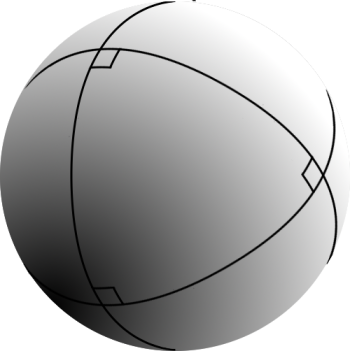
At its core, spherical trigonometry deals with spherical triangles, which are formed by the intersection of three great circles on the surface of a sphere. Key relationships are expressed through laws such as the spherical law of sines (sin a / sin A = sin b / sin B = sin c / sin C) and the spherical law of cosines (cos a = cos b cos c + sin b sin c cos A), which relate the lengths of the sides (a, b, c) to the measures of the opposite angles (A, B, C). The sum of the angles in a spherical triangle is always greater than 180 degrees, with the excess directly proportional to the triangle's area.
📊 Key Facts & Numbers
The sum of the angles in a spherical triangle can range from just over 180 degrees to less than 540 degrees. The Law of Haversines, a specific formulation derived from the spherical law of cosines, is particularly useful for calculating short distances on Earth's surface, with errors typically less than 0.1% for distances up to 1000 km. The maximum possible area for a spherical triangle is half the surface area of the sphere, occurring when it covers a hemisphere.
👥 Key People & Organizations
The development of spherical trigonometry is indebted to numerous brilliant minds. Later, John Napier introduced logarithms, which greatly simplified calculations involving trigonometric functions. Modern contributions come from mathematicians and physicists working in fields like celestial mechanics and differential geometry, often associated with institutions like the University of Cambridge and the French Academy of Sciences.
🌍 Cultural Impact & Influence
Spherical trigonometry has been an indispensable tool in shaping human understanding of the cosmos and our place within it. Its application in celestial navigation allowed mariners to determine their position at sea using star positions, fundamentally enabling global exploration and trade during the Age of Discovery. In astronomy, it underpins the calculation of star positions, planetary movements, and the understanding of celestial phenomena like eclipses. The very concept of mapping the Earth's surface, or geodesy, relies heavily on spherical geometry to account for the planet's curvature, influencing cartography and surveying. The cultural impact is profound, embedding a sense of global interconnectedness and a scientific understanding of the heavens into societies worldwide.
⚡ Current State & Latest Developments
While the fundamental principles of spherical trigonometry remain constant, its application and computational methods are continuously refined. The advent of Global Positioning System (GPS) and other satellite navigation systems has shifted some traditional navigation techniques, but the underlying spherical geometry is still crucial for understanding satellite orbits and signal triangulation. Researchers are increasingly applying advanced mathematical tools, such as quaternions and Clifford algebra, to solve complex problems in areas like robotics and computer graphics, offering more elegant and efficient solutions than traditional methods. The development of sophisticated computational algorithms and software continues to enhance its utility in scientific research and engineering.
🤔 Controversies & Debates
A long-standing debate centers on the most effective pedagogical approach to teaching spherical trigonometry. Some argue for a return to traditional methods emphasizing geometric intuition and manual calculation, akin to the approaches used by Ptolemy and Al-Battani. Others advocate for a modern approach that integrates computational tools and vector methods from the outset, viewing it as a stepping stone to more advanced mathematical concepts. There's also a subtle tension between its historical significance in navigation and its current role as a foundational element in more abstract mathematical and physical theories, leading some to question its direct relevance in an era of digital navigation.
🔮 Future Outlook & Predictions
The future of spherical trigonometry is intrinsically linked to advancements in fields that rely on understanding curved spaces and precise spatial relationships. As humanity ventures further into space exploration, the need for accurate calculations of orbital mechanics and interplanetary navigation will only increase, demanding sophisticated applications of spherical geometry. Furthermore, the burgeoning fields of virtual reality and augmented reality require precise spatial mapping and rendering on curved surfaces, potentially leading to new algorithms and techniques rooted in spherical trigonometry. The ongoing development of computational mathematics and artificial intelligence may also unlock novel ways to solve complex spherical problems, pushing the boundaries of what's currently possible.
💡 Practical Applications
Spherical trigonometry's practical applications are vast and critical. It is the bedrock of celestial navigation, enabling sailors and aviators to determine their position using the stars. In astronomy, it's used to calculate the positions of celestial objects, predict eclipses, and map the night sky. Geodesy and cartography rely on it to accurately map the Earth's curved surface, essential for surveying, land management, and global mapping projects. Surveying large distances, especially over continents or oceans, requires accounting for Earth's curvature, a task handled by spherical trigonometry. Even in modern contexts, it's vital for GPS and other satellite navigation systems, as well as in fields like robotics for path planning and computer graphics for rendering curved surfaces.
Key Facts
- Category
- science
- Type
- topic