
Contents
Overview
The genesis of spirometry can be traced back to the late 18th century, with early pioneers like John Hutchinson developing rudimentary devices to measure lung volume. Hutchinson's 'spirometer,' introduced around 1846, was a water-sealed bell apparatus that allowed individuals to inhale and exhale, with the displaced water indicating lung capacity. This marked a significant departure from purely qualitative observations of breathing. By the early 20th century, advancements by figures such as William H. King Jr. and the development of more sophisticated electronic sensors began to refine the accuracy and utility of spirometers, paving the way for standardized testing protocols that would emerge later in the century, notably influenced by organizations like the American Thoracic Society.
⚙️ How It Works
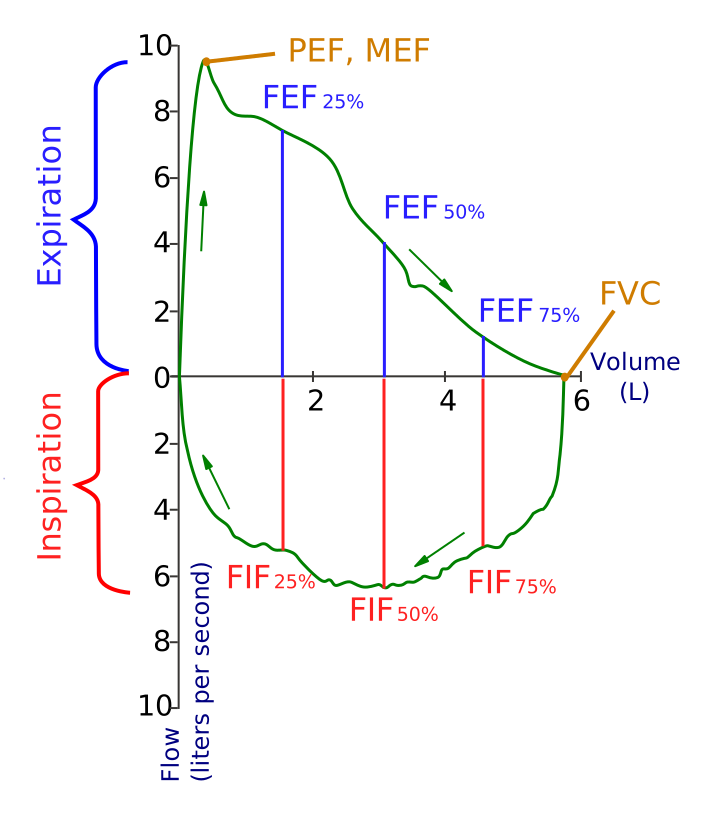
At its core, spirometry involves a patient taking a maximal inhalation and then exhaling as forcefully and rapidly as possible into a device called a spirometer. This device, often connected to a computer system, records the volume of air exhaled over time. Key metrics derived include Forced Vital Capacity (FVC), the total amount of air that can be forcibly exhaled from the lungs after a maximal inhalation, and Forced Expiratory Volume in one second (FEV1), the volume of air exhaled during the first second of the FVC maneuver. The spirometer captures this data, often displaying it as a volume-time curve and a flow-volume loop, which visually represents the speed and volume of air expelled.
📊 Key Facts & Numbers
Globally, spirometry is performed millions of times annually. The FEV1 metric is a critical diagnostic threshold. For asthma, reversibility testing, where spirometry is repeated after administering a bronchodilator, is crucial. In COPD diagnosis, severity is assessed based on FEV1 values. For example, mild COPD is associated with higher FEV1 values, while very severe COPD is associated with significantly lower FEV1 values. These metrics are vital for diagnosing and monitoring respiratory diseases.
👥 Key People & Organizations
While John Hutchinson is credited with the early spirometer, the standardization and clinical integration of spirometry owe much to organizations like the American Thoracic Society (ATS) and the European Respiratory Society (ERS). These bodies have collaborated on guidelines for performing and interpreting spirometry, most notably the joint ATS/ERS Task Force reports, which have been updated periodically since the 1990s. Companies such as NDD Medical and Vitalograph are prominent manufacturers of modern spirometry devices, providing the technology used in clinics worldwide. Researchers like Don Tan have contributed to refining predictive equations for lung function across diverse populations.
🌍 Cultural Impact & Influence
Spirometry has profoundly influenced clinical medicine, shifting the diagnosis and management of respiratory diseases from subjective symptom assessment to objective, quantifiable data. Its widespread adoption in primary care, pulmonology clinics, and occupational health settings has standardized the evaluation of lung health. The visual representation of lung function via flow-volume loops has become an iconic image in respiratory medicine, appearing in countless textbooks and educational materials. Furthermore, spirometry data has been instrumental in epidemiological studies, helping to map the prevalence and progression of lung diseases across different geographic regions and demographic groups, as seen in large-scale studies like the Global Burden of Disease Study.
⚡ Current State & Latest Developments
The current landscape of spirometry is characterized by increasing integration with digital health platforms and the development of portable, user-friendly devices. Tele-spirometry, enabling remote patient monitoring, has gained significant traction, particularly accelerated by the COVID-19 pandemic. Innovations include AI-powered interpretation tools that assist clinicians in analyzing results and identifying subtle abnormalities. Efforts are also underway to improve accessibility and usability in low-resource settings, with research focusing on smartphone-based spirometry applications that leverage device sensors and cloud-based analysis, exemplified by projects from institutions like the University of California, San Diego.
🤔 Controversies & Debates
A persistent debate revolves around the optimal standardization of spirometry, particularly concerning patient effort and technique, which can significantly impact results. While ATS/ERS guidelines provide a robust framework, achieving consistent, high-quality effort across all patients and testing environments remains a challenge. There's also ongoing discussion about the clinical utility and cost-effectiveness of routine spirometry screening in asymptomatic individuals versus targeted screening in high-risk populations, such as smokers or those with occupational exposures. The interpretation of borderline results, especially in the context of early-stage disease or mixed restrictive/obstructive patterns, also presents a point of contention among clinicians.
🔮 Future Outlook & Predictions
The future of spirometry points towards greater personalization and predictive capabilities. Advancements in artificial intelligence and machine learning are expected to enhance diagnostic accuracy, potentially identifying disease patterns earlier than currently possible. Integration with other 'omics' data (genomics, proteomics) could lead to more precise phenotyping of respiratory diseases, guiding tailored therapeutic strategies. Furthermore, the development of wearable spirometry sensors could enable continuous or near-continuous monitoring of lung function, providing real-time insights into disease status and treatment response, potentially revolutionizing the management of chronic respiratory conditions and transforming telemedicine applications.
💡 Practical Applications
Spirometry's primary application is in the diagnosis and management of respiratory diseases. It's crucial for identifying and staging COPD, assessing the severity and reversibility of asthma, and diagnosing conditions like pulmonary fibrosis and bronchiectasis. In occupational health, it's used for pre-employment screenings and ongoing surveillance to detect work-related lung damage from exposures to dusts, chemicals, or fumes in industries like mining, manufacturing, and agriculture. It also plays a role in pre-operative assessment to evaluate surgical risk, particularly for thoracic or abdominal surgeries, and in monitoring the effects of certain medications known to impact lung function.
Key Facts
- Category
- science
- Type
- technology