
Contents
Overview
Tensegrity, a portmanteau of 'tension' and 'integrity,' describes structures that achieve stability through a balance of continuous tension members and discontinuous compression members. Unlike traditional rigid structures, tensegrity systems appear to float, with compression elements suspended by a network of tensioned cables. This unique structural principle, popularized by Buckminster Fuller, offers remarkable strength-to-weight ratios and resilience. Its applications span architecture, art installations, robotics, and even biological systems, challenging conventional engineering paradigms. Understanding tensegrity involves grasping how pre-stressed components create a cohesive, stable whole that can adapt to external forces.
🏗️ What is Tensegrity?
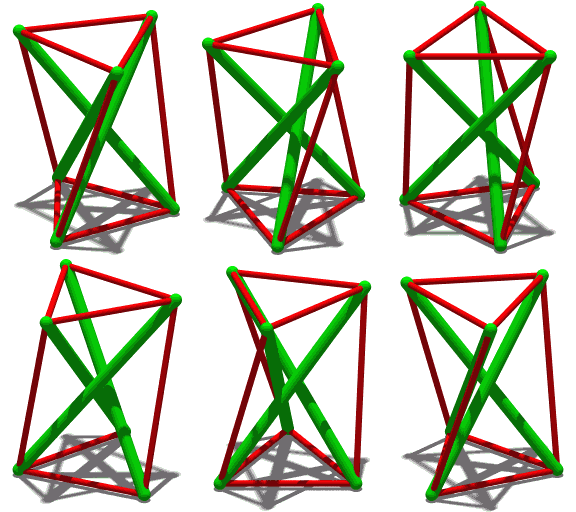
Tensegrity, a portmanteau of 'tensional integrity,' is a revolutionary structural design principle that defies conventional engineering. Instead of relying on continuous compression, tensegrity structures utilize a network of isolated compression elements (like struts or bars) suspended within a continuous network of tension elements (like cables or tendons). This creates a self-stressing system where the compression members never physically touch, allowing for remarkably lightweight yet incredibly strong and resilient constructions. Think of it as a carefully balanced act of forces, where tension holds compression in check, enabling structures to 'float' with an inherent lightness.
💡 The Core Principle Explained
At its heart, tensegrity operates on a fundamental principle: discontinuous compression within a continuous tension field. Imagine a bicycle wheel; the spokes are under tension, pulling the rim towards the hub, while the hub and rim are in compression. In a tensegrity system, this concept is amplified. The tension members are pre-stressed, creating a constant, inherent tension throughout the network. This tension then supports and stabilizes the compression members, preventing them from buckling or collapsing. The result is a structure that is inherently stable and can deform elastically without catastrophic failure, a stark contrast to rigid, load-bearing systems.
📐 Key Components & Design
The building blocks of a tensegrity structure are deceptively simple: compression elements and tension elements. Compression members, often rigid bars or struts, are strategically placed so they are not in direct contact. They are held apart and in position by the tension network, typically composed of cables, wires, or elastic bands. The geometry and pre-tensioning of these elements are critical. Precise calculations are required to ensure the system achieves a state of 'self-stress,' where the internal forces are balanced, and the structure maintains its form. The interplay between the length and arrangement of compression members and the tension in the cables dictates the overall shape and load-bearing capacity.
⚖️ Advantages Over Traditional Structures
The advantages of tensegrity over traditional structural forms are significant. Its most striking benefit is its exceptional strength-to-weight ratio. Because compression members are isolated and supported by tension, they can be made much thinner and lighter than in conventional designs, reducing material costs and transportation challenges. Tensegrity structures also exhibit remarkable resilience and flexibility. They can absorb and dissipate energy, making them ideal for seismic zones or applications requiring shock absorption. Furthermore, their aesthetic potential is vast, offering architects and designers the ability to create visually striking, seemingly gravity-defying forms.
🚧 Common Applications & Examples
Tensegrity's unique properties lend themselves to a diverse range of applications. In architecture, it's seen in lightweight, deployable shelters, complex roof structures, and artistic installations that challenge perception. In robotics, tensegrity principles are being explored for creating highly adaptable and resilient robotic limbs and bodies that can navigate complex terrains. Even in biology, the concept is being studied as a model for cellular structures and muscle function. Famous examples include the 'Tensegrity Sphere' by Buckminster Fuller and various modern architectural marvels that showcase its aesthetic and engineering prowess.
🤔 Who Benefits from Tensegrity?
This innovative structural approach appeals to a broad spectrum of individuals and industries. Architects and designers are drawn to its aesthetic possibilities and its ability to create unique spatial experiences. Engineers, particularly in aerospace and robotics, find value in its lightweight strength and resilience. Material scientists are exploring its potential for developing advanced composite materials. Even artists and sculptors are captivated by its ability to create dynamic, visually arresting forms. Anyone seeking to push the boundaries of structural design, optimize material usage, or create visually compelling, lightweight structures will find tensegrity compelling.
📚 Learning & Resources
For those eager to explore tensegrity further, a wealth of resources exists. Buckminster Fuller's foundational work provides the philosophical and theoretical underpinnings. Numerous academic papers and engineering journals detail the mathematical principles and structural analysis required for tensegrity design. Online tutorials and DIY kits offer hands-on experience in building smaller tensegrity models, demonstrating the principles in practice. Universities with strong architecture and structural engineering programs often feature tensegrity in their curriculum, providing formal education and research opportunities.
🚀 The Future of Tensegrity
The future of tensegrity appears exceptionally bright, poised to move beyond niche applications into mainstream engineering and design. As computational power increases, enabling more complex simulations and optimizations, the design and construction of larger, more sophisticated tensegrity structures will become more feasible. We can anticipate seeing tensegrity principles integrated into everything from sustainable housing and deployable infrastructure for disaster relief to advanced aerospace components and bio-inspired robotics. The ongoing research into smart materials and adaptive structures further suggests that tensegrity will be a key enabler of next-generation engineering solutions.
Key Facts
- Year
- 1962
- Origin
- Buckminster Fuller's conceptualization and popularization, though roots can be traced to artists like Kenneth Snelson.
- Category
- Structural Engineering & Design
- Type
- Concept
Frequently Asked Questions
Is tensegrity suitable for large-scale construction like bridges or skyscrapers?
While tensegrity offers incredible strength-to-weight ratios, scaling it up for massive structures like bridges or skyscrapers presents significant engineering challenges. The complexity of managing pre-tensioning across vast spans and ensuring long-term durability under extreme environmental loads requires extensive research and development. However, its principles are being explored for components within larger structures or for specialized applications like deployable bridges.
How does tensegrity compare to geodesic domes in terms of stability?
Both tensegrity structures and geodesic domes, pioneered by Buckminster Fuller, are known for their efficiency and strength. Geodesic domes distribute stress across their entire surface, creating a highly stable spherical form. Tensegrity, on the other hand, achieves stability through a dynamic balance of tension and compression. While geodesic domes are rigid, tensegrity structures can exhibit more elastic deformation, making them potentially more resilient to dynamic loads and impacts.
What are the primary materials used in tensegrity structures?
The primary materials are compression elements (often rigid bars made of metal, carbon fiber, or strong plastics) and tension elements (typically high-strength cables, wires, or specialized ropes). The choice of materials depends on the scale, intended use, and environmental conditions of the structure. For smaller models, common materials might include wooden dowels and elastic cords.
Can tensegrity structures be easily assembled and disassembled?
Yes, one of the key advantages of tensegrity is its potential for modularity and ease of assembly/disassembly. Many tensegrity designs are inherently deployable, making them ideal for temporary structures, emergency shelters, or portable installations. The lightweight components and the way they interlock can simplify construction processes significantly.
What is the role of pre-stressing in tensegrity?
Pre-stressing is fundamental to tensegrity. It's the process of applying an initial tension to the tension network before the structure is subjected to external loads. This pre-stress ensures that the tension members are always taut and that the compression members are held in place, creating the stable, self-balancing system. Without adequate pre-stress, the structure would be loose and unable to maintain its intended form or load-bearing capacity.